


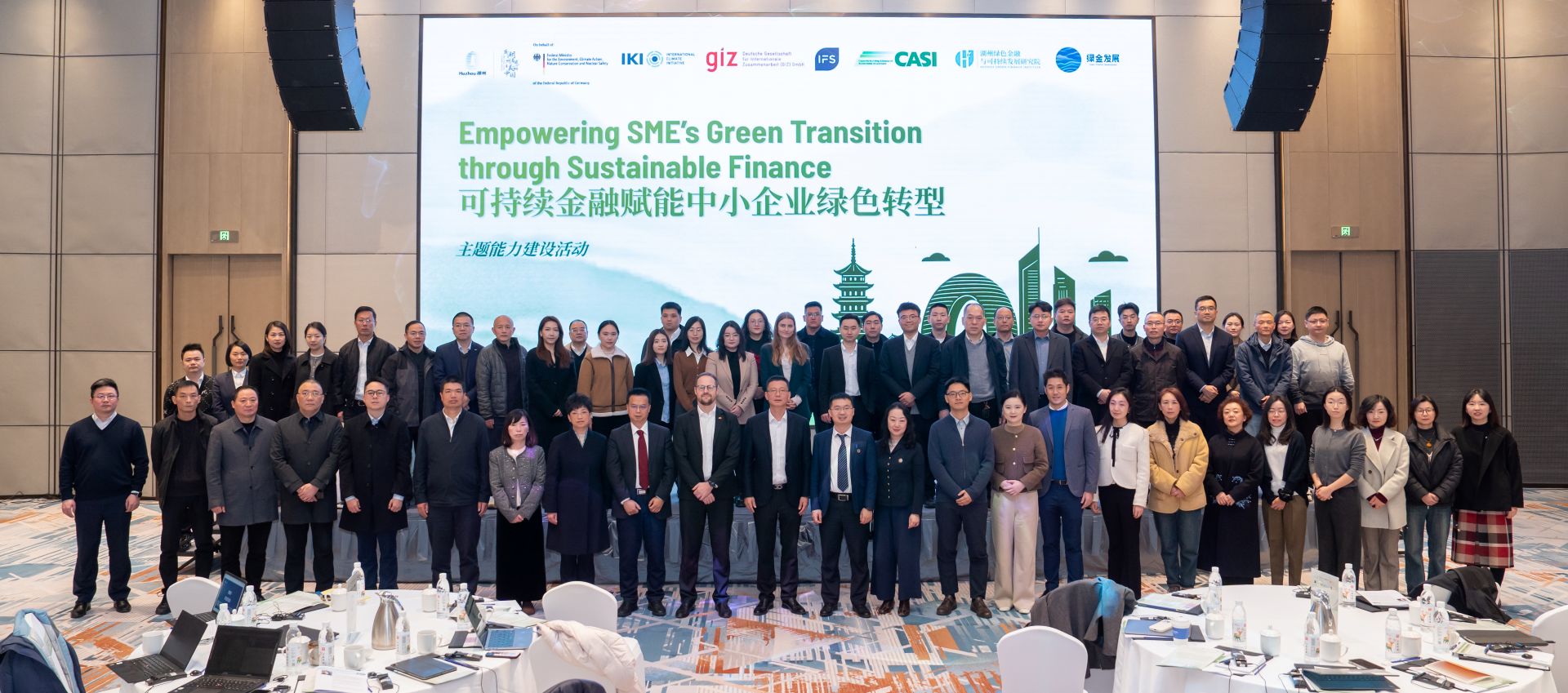
Huzhou, Zhejiang Province, China – December 5, 2025 – the CASI TA Study Tour themed “Sustainable Finance Empowering SMEs’ Green Transition” jointly organized by the Deutsche Gesellschaft für Internationale Zusammenarbeit (GIZ), the Institute of Finance and Sustainability (IFS), the Capacity-building Alliance of Sustainable Investment (CASI), the Huzhou Green Finance Development Service Center, the Huzhou Green Finance Institute (HZGF), and Huzhou Green Finance Development Center Co., Ltd., was successfully held in Huzhou
The first day featured the TA Workshop, which focused on how sustainable finance system development and innovative practices can support SMEs in strengthening their capacity for low-carbon transition. Centred on three core themes—transition finance, supply-chain finance, and financial technology innovation—the Workshop provided a platform for knowledge sharing and experience exchange to advance local practices.
In his opening remarks, Mr. Pan Chunhui, Deputy Secretary-General of the Huzhou People’s Government, noted that as the birthplace of the concept “Lucid waters and lush mountains are invaluable assets,” Huzhou has consistently adhered to a green development pathway. Since becoming one of the first national pilot zones for green finance reform and innovation in 2017, the city has achieved a number of nationwide firsts, with the share of green credit far exceeding the national average, and is actively advancing transition finance pilots. Mr. Pan also emphasized that green finance is an important engine for supporting sustainable development, and Huzhou looks forward to deepening cooperation with all parties to jointly contribute wisdom and strength to SMEs’ green transition.
Mr. Cheng Lin, Director of Center for International Collaborations at the Institute of Finance and Sustainability (IFS) and Head of the CASI Secretariat, noted that CASI has long been committed to advancing international exchange and capacity building in sustainable finance. He recalled that in June 2024, CASI invited over 50 international representatives to Huzhou to engage in exchanges on local green finance practices, and in October 2025, led a delegation from Bank Negara Malaysia on a study visit to the city. He emphasised that Huzhou’s exploration in green finance reform has attracted wide attention both domestically and internationally, and that incorporating more international perspectives would help present the value of Huzhou’s practices in a more comprehensive and diversified manner.
Dr. Janto Hess, Project Director of the Sino-German Cooperation on Climate Change – Climate Partnership at GIZ, noted in his remarks that GIZ has been deeply engaged in supporting the development of China’s green finance market since 2016. He spoke highly of Huzhou’s benchmark achievements as one of China’s first pilot zones for green finance reform and innovation, and emphasised that the Huzhou event represents an important step in aligning national sustainable finance strategies with local-level implementation. He highlighted that the initiative aims to equip financial institutions and enterprises—particularly SMEs—with systematic tools and methodologies to integrate climate and sustainability considerations into core business decision-making, jointly explore pathways towards more ambitious climate targets, and inject new momentum into local green and low-carbon transition.
The Workshop was moderated by Ms. Qi Lan, Team Lead of the Sector Team on Climate and Senior China Coordinator for the EU Climate Dialogues (EUCDs2) at GIZ East Asia. She noted that over the past decade, China’s green and low-carbon transition efforts have largely focused on large enterprises and listed companies, while SMEs face structural constraints in terms of limited resources and professional expertise. As a result, many SMEs struggle to develop credible and comprehensive transition plans, and lack the capacity to formulate long-term strategies extending towards 2060. She emphasized that SMEs are a critical pillar of the national economy, and that the success or failure of their transition will directly shape the overall trajectory of economic transformation, underscoring the urgent need for innovative and differentiated financial products to provide targeted support.
Speakers in Session 1 presented on Transition Finance for Real-Economy Transformation, highlighting its crucial role in supporting high-carbon sectors to reduce emissions and enabling SMEs’ low-carbon transition. Mr. Cheng Lin (IFS/CASI) introduced the Look-back Loan (LTL) mechanism, explaining how it strengthens transition commitments, increases flexibility of financial instruments, and links incentives to verified post-disbursement performance. Ms. Guo Fang (IFS) emphasized the importance of clear decarbonization pathways and sector benchmarks, showcasing industry transition targets developed using CGE models and the CRTT tool to guide financial institutions’ planning. Addressing SMEs’ needs, Ms. Deng Lulu (Menglang Digital Technology) demonstrated how digital carbon accounts and carbon rating systems can improve carbon data management and ease financing barriers along supply chains. Mr. Wang Zhijun (Tianneng Group) shared practical supply-chain finance experiences, illustrating how collaboration with banks and partners can support high-quality green transition.
In Session 2, Ms. Zhang Ninghui (CASI) moderated the panel discussion on Financing the Green Transition of SMEs – Role of Supply Chains through Innovation. Experts highlighted that SMEs must shift from passively bearing regulatory and market pressures to proactively leveraging clusters, shared resources, and joint mechanisms, with technology, business-model, and financial-product innovations driving green transition. Mr. Ren Feizhou (Huzhou Bank) noted SMEs’ challenges in funding, carbon data, and transparency, sharing that Huzhou Bank has supported 200+ industrial chains and 5,000+ SMEs with innovative green finance solutions. Ms. Su Ting (WRI) emphasized the lead firms’ pivotal role in driving SMEs’ green upgrades. Mr. Ding Zhengkai (TÜV Rheinland China) and Ms. Wang Liting (SGS China) highlighted the need for digital tools and collaborative mechanisms to ensure data quality, compliance, and systemic greening across supply chains.
Session 3 focused on Financing Resilience – Empowering SMEs to Thrive amid Climate and Market Transitions. Ms. Zhu Yun (IFC) presented strategies for helping financial institutions manage climate risks and seize adaptation opportunities, illustrating with international cases such as resilient housing in Mexico and smart grids in Colombia, alongside domestic opportunities like sponge cities and smart agriculture. Ms. Chen Yingjie (Huzhou Green Finance Institute) highlighted local experiences and innovative financial tools, emphasizing integrated “government–financial institution–enterprise” approaches and products like weather-index insurance to strengthen regional resilience and support SMEs in their low-carbon transition.
In the panel discussion of Session 4, themed Advancing Green Fintech – Driving the Green Transition of SMEs through Innovation, Inclusion, and Cost Reduction, experts examined how digital technologies can accelerate SMEs’ green transition while reducing costs and increasing financial inclusion. Mr. Qian Hailiang (Huzhou Green Finance Development Center Co., Ltd.) shared the city’s digital infrastructure initiatives, including carbon accounts, green project libraries, and smart supervision platforms, illustrating how these tools lower barriers and optimize financing conditions for SMEs. Mr. Wei Mengyu (Ant Digital Technologies) highlighted blockchain and trustworthy data systems as foundational enablers for green finance, and presented cross-institutional and cross-regional collaboration practices to enhance transparency, efficiency, and data credibility in supporting SMEs’ low-carbon transformation.
In his closing remarks, Mr. Cheng Lin emphasized that promoting SMEs’ sustainable transition is a key lever for achieving high-quality economic development and building a climate-resilient society. As a platform for capacity-building in sustainable investment, CASI will continue integrating international experience with local practices, serving as a bridge for knowledge sharing and in-depth dialogue. He expressed hope that future initiatives in Huzhou would involve more advanced, internationalized, and sector-specific workshops and collaborations, collectively helping SMEs seize green transition opportunities.
A highlight of the study tour was a full-day site visit. At the Huzhou Urban Planning Exhibition Hall and the South Taihu Green Finance Harbour, participants explored Huzhou’s comprehensive green development blueprint and practical implementation. The delegation then visited Tianneng Group to observe firsthand how green finance supports the traditional manufacturing sector’s successful transition to a circular economy, demonstrating the effectiveness of industry-finance collaboration. At Changxing Rural Commercial Bank, participants learned about the bank’s carbon-efficient financing platform for SMEs, showcasing how local financial institutions leverage digital tools to lower barriers for green transformation and combine inclusive finance with low-carbon development. Together, these visits illustrated Huzhou’s coordinated approach to policy guidance, industrial upgrading, and financial empowerment in advancing SMEs’ sustainable development.
