


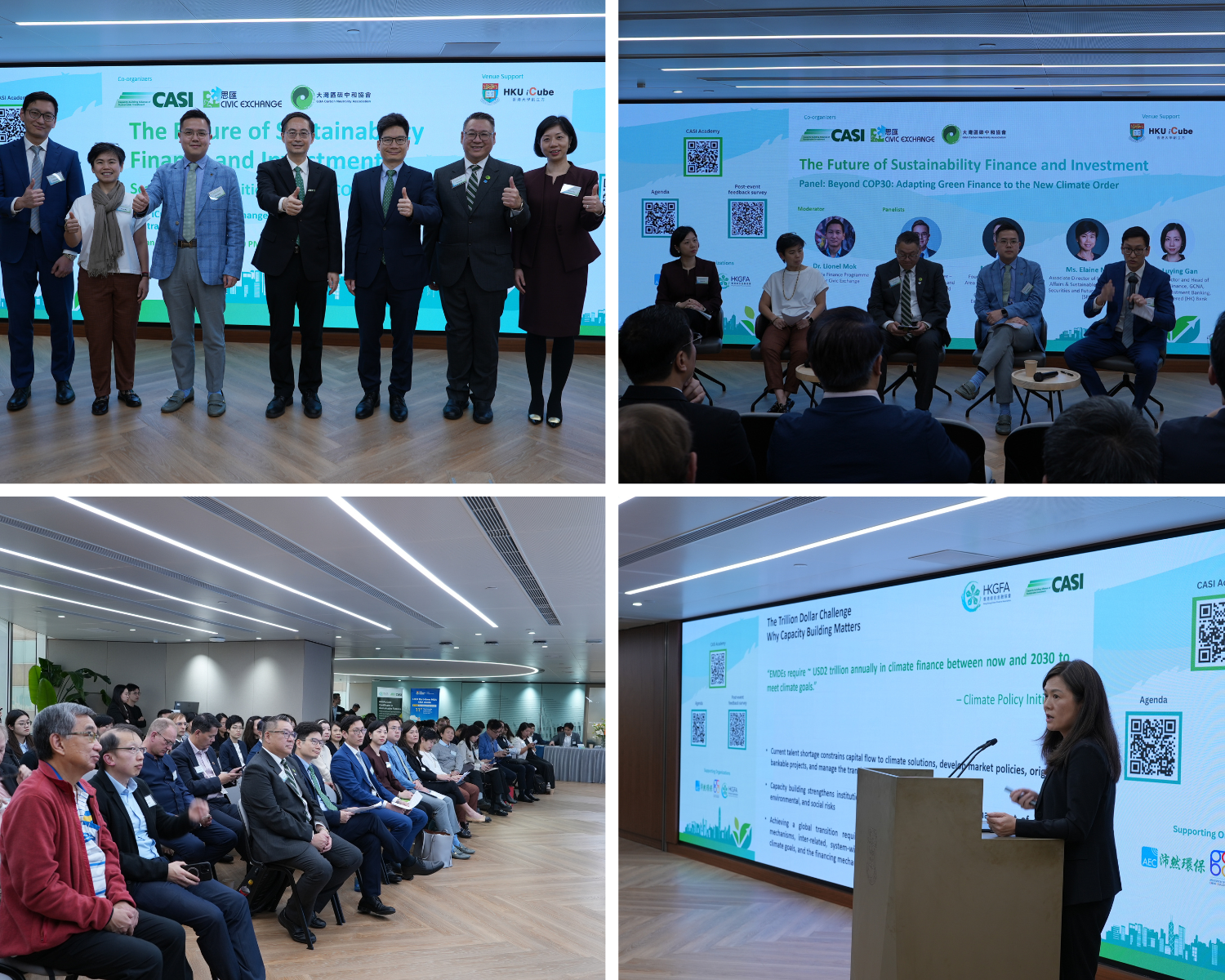
[Hong Kong, January 29, 2026] —“The Future of Sustainability Finance and Investment – Scaling the Transition Beyond COP30” was successfully held on January 27, 2026, at HKU iCube in Central. The event was co-hosted by the Capacity Building Alliance of Sustainability Investment (CASI), Civic Exchange, and the Greater Bay Area Carbon Neutrality Association (GBACNA). As part of Hong Kong’s International Financial Week, the forum brought together leaders from finance, policy, and industry to explore practical and scalable pathways for accelerating green investment across Asia and the Global South. The seminar also received support from the Hong Kong Green Finance Association (HKGFA), the Association of Blockchain Development, Allied Sustainability and Environmental Consultants Group Limited (AEC Group), and HKU iCube for the venue support.
Opening Insights: A Shifting Global Landscape
In his opening remarks, Dr. Ma Jun, MH, Chairman of HKGFA and CASI, highlighted the shifting global climate finance landscape where developed economies' capacity to support the Global South’s climate finance is weakening. He emphasized that Asia must assume a larger role and outlined three priorities: 1) Scaling up the sustainable finance ecosystem through interoperable taxonomies and disclosure requirements; 2) Advancing financial innovation such as blended finance, tools for transition & nature transition, digital finance and tokenization; and 3) Leveraging the significant cost advantage of local-currency financing including in the RMB market.
Hong Kong’s Strategic Leadership in Green Finance
Mr. Joseph H. L. Chan, JP, Under Secretary for Financial Services and the Treasury of the Hong Kong SAR Government, delivered a keynote address underscoring Hong Kong's dual drive from strategic responsibility and strong market demand. He highlighted Hong Kong’s market leadership, accounting for about 45% of Asia’s green and sustainable bond issuance in 2024 and hosting over 200 SFC-authorized ESG funds with AUM exceeding HKD 1.1 trillion. Looking ahead, he outlined continued government support through benchmark green bond issuance, subsidies, and critical initiatives like the Common Ground Taxonomy (CGT) and the adoption of ISSB standards by 2027. He also addressed the talent shortage challenge and corresponding government capacity-building measures.
Panel Discussion: Adapting to the New Climate Order
A pivotal panel session, “Beyond COP30: Adapting Green Finance to the New Climate Order,” was moderated by Dr. Lionel Mok, Sustainable Finance Programme Lead for Civic Exchange. The discussion featured insights from distinguished speakers across the public and private sectors:
· Mr. Bien Wong, Assistant General Manager – Group ESG, The Hong Kong and China Gas Company Limited
· Mr. Dennis Wu, Founding President, Greater Bay Area Carbon Neutrality Association (GBACNA) & Chief Executive Officer and Executive Director, AEC Group
· Ms. Elaine Ng, Associate Director of International Affairs & Sustainable Finance, The Securities and Futures Commission (SFC)
· Ms. Luying Gan, Managing Director and Head of Sustainable Finance, GCNA, Corporate & Investment Banking, Standard Chartered (HK) Bank
The panel examined Hong Kong’s evolving role in sustainable finance, highlighting its position as a “super-connector” and innovator (including tokenized green bonds) alongside the need to adapt global standards such as the ISSB to local realities (Elaine Ng, SFC). Speakers also underscored Hong Kong’s broad suite of sustainable finance products and its role in connecting cross-border projects, with climate risk disclosure remaining a core client requirement (Luying Gan, Standard Chartered). In this context, Hong Kong can serve as a “Value‑added Connector”. From an industry perspective, decarbonization policy is increasingly shaping business strategy—driving initiatives in areas like hydrogen and sustainable aviation fuel—while reinforcing the case for regulatory flexibility (Bien Wong, HK & China Gas). Looking ahead, COP30 priorities around financing nature-based solutions and a just transition were noted, as well as the growing role of AI in enabling new green finance products (Dennis Wu, GBACNA/AEC).
Building Capacity for the Transition
The programme also featured an update from Ms. Jenny Lee, Deputy Secretary General of HKGFA, who introduced the new certificate program – “HKGFA-CASI Certificate in Sustainable Finance” designed to address critical expertise gaps in developing markets, the practical, implementation-oriented program covers six core modules including green taxonomies and transition finance, leveraging a global network with a focus on emerging economies – The programme is now available for trial on the CASI Academy e-learning platform and will be officially launched in Q1 2026.
Closing Perspectives: New Models and Hong Kong’s Hub Role
In his closing summary, Dr. Ma Jun shared his takeaways from COP30 and pointed to emerging models like Brazil’s Tropical Forestry Forever Fund as potential breakthroughs beyond traditional aid. Moreover, he underscored urgent needs: greater interoperability of taxonomies, harmonization of carbon markets, and developing credible benchmarks for transition finance in emerging markets. He highlighted the opportunity to scale Chinese green technologies globally using low-cost RMB financing and proposed establishing a Green Project Accelerator in Hong Kong to de-risk projects for developing Asia.
Mr. Dennis Wu, in his closing remarks, reaffirmed Hong Kong’s distinctive role as a strategic bridge linking policy, capital, and real-economy projects. He outlined priorities for the future: deepening cross-border collaboration, investing in practical capacity building, and driving innovation to convert climate pledges into investable projects.
The seminar concluded with a networking session, fostering collaboration among participants to further advance Hong Kong’s green finance ecosystem.
---
For media enquiries, please contact:
The Capacity Building Alliance of Sustainability Investment (CASI),
Ms. Jessica Tsang
jessica.tsang@sprinkles.org.hk
